Artist Spotlight
Timeless Companions: How Julianne Sayer Builds a World in Cloth
A portrait of slow construction, visible stitches, and the small narrative choices that turn fabric into a collectible character.
By Sophie Harrow
· 5 min read
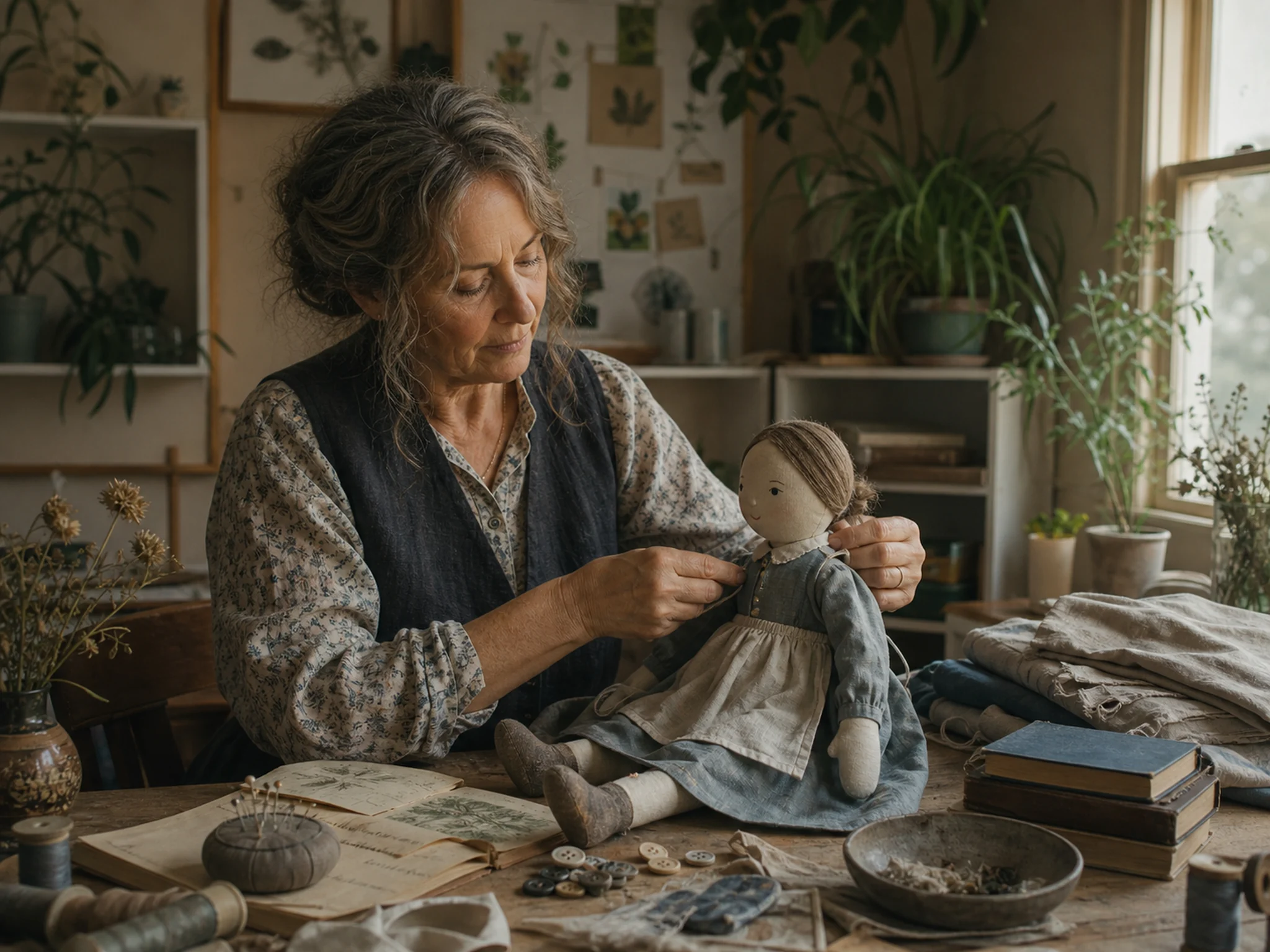
A cloth doll begins as a flat decision. A curve is drawn on paper, transferred to fabric, cut twice, and stitched around the edge. Before stuffing, the shape barely suggests a body. It is only when the seams are turned, filled, weighted, and joined that posture appears.
For Bristol-based maker Julianne Sayer, that transition is the core of the work. She is less interested in making an immaculate miniature person than in discovering how little information a figure needs before it starts to feel present. A slight lean, a heavy skirt, two closely placed eyes, or a hand that sits awkwardly against an apron can carry more character than a highly detailed face.
Art dolls occupy an unusual position between sculpture, textile art, design object, and familiar domestic companion. Museums hold dolls made from wood, clay, wool, cloth, hide, beads, and found materials, and those objects have served many purposes beyond play: cultural record, teaching object, ritual form, fashion model, community enterprise, and personal keepsake. Contemporary makers inherit that broad material language even when their work is made for a shelf rather than a toy box.
Beginning with cloth
Sayer’s studio practice starts with washed linen in muted colors: oat, smoke, faded blue, soft brown. The fabric is marked with paper patterns, but the cutting is not exact. She leaves room for the weave to shift and for the stuffed form to pull slightly out of symmetry.
That irregularity is intentional. A perfectly mirrored body can feel manufactured, while a small difference between the shoulders or the angle of the feet gives the eye something to hold onto. The maker’s task is not to remove every variation, but to decide which variations help the figure feel coherent.
The internal structure is simple. Wool batting creates a firm but slightly yielding body. Strong cotton thread closes the seams. A few hidden anchor stitches keep the head from tilting too far. The result remains recognizably textile: it compresses, creases, and records pressure in a way that resin or porcelain does not.
“The face is usually the quietest part. I want the clothes, posture, and materials to do most of the speaking.” — Julianne Sayer
Clothing as a form of memory
The garments are built after the body is complete. Sayer treats them neither as accessories nor as exact historical costume. Instead, she borrows construction details from ordinary clothing: a gathered cuff, a patched pocket, a collar softened by wear, a row of mismatched buttons.
Her reference shelf includes gardening notebooks, old school photographs, children’s illustrations, mending manuals, seed packets, and family snapshots found at markets. The details are not copied literally. They are reduced into a vocabulary of checks, faded florals, narrow stripes, and small embroidered plants.
Embroidery is added late. A flower at the hem may take longer than the face, partly because the thread must pass through several layers without puckering the garment. The work is slow, but the finished mark should not feel precious. Loose ends are secured, not hidden under excessive finishing. The stitch remains evidence of the hand.
Why softness changes the encounter
Soft figures are often described as comforting, but softness also changes how an object occupies space. A cloth body sits differently on each surface. It slumps, settles, and responds to support. Even when collectors are advised not to handle a piece unnecessarily, the viewer can understand its weight through the folds and pressure points.
That physical readability matters to Sayer. She designs the figures to look stable rather than fragile, with low centers of gravity and clothing that supports the silhouette. A long skirt may conceal a weighted base. A coat may widen the shoulders. A basket or book may balance the direction of the head.
The figures are not designed for children’s play. Small buttons, wire elements, and delicate surface work make them display objects. But the visual language of softness keeps them from feeling remote. They remain close to everyday life: fabric, thread, mending, pockets, and clothing.
Building a series without repeating a formula
A series begins with a shared constraint. One group may use only blue, cream, and brown. Another may center on market errands, with each figure carrying a different object. Repeated patterns give the collection visual unity, but each doll needs one decisive variation.
For Meadow Girl, that variation is a basket held slightly too low, making the body lean. Market Day uses a deeper apron and a shorter stance. A third figure may have no accessory at all, relying on an embroidered collar and turned feet.
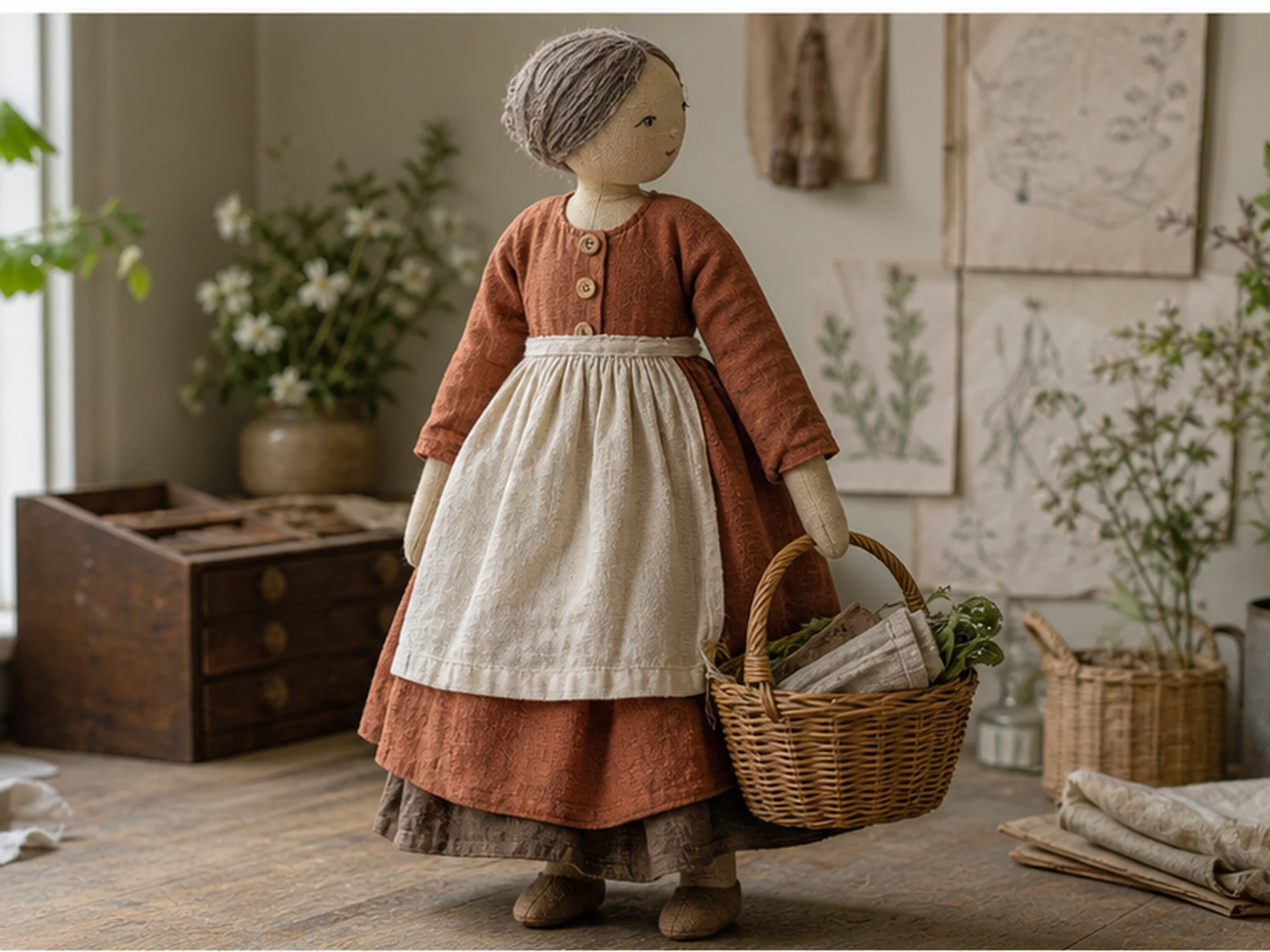
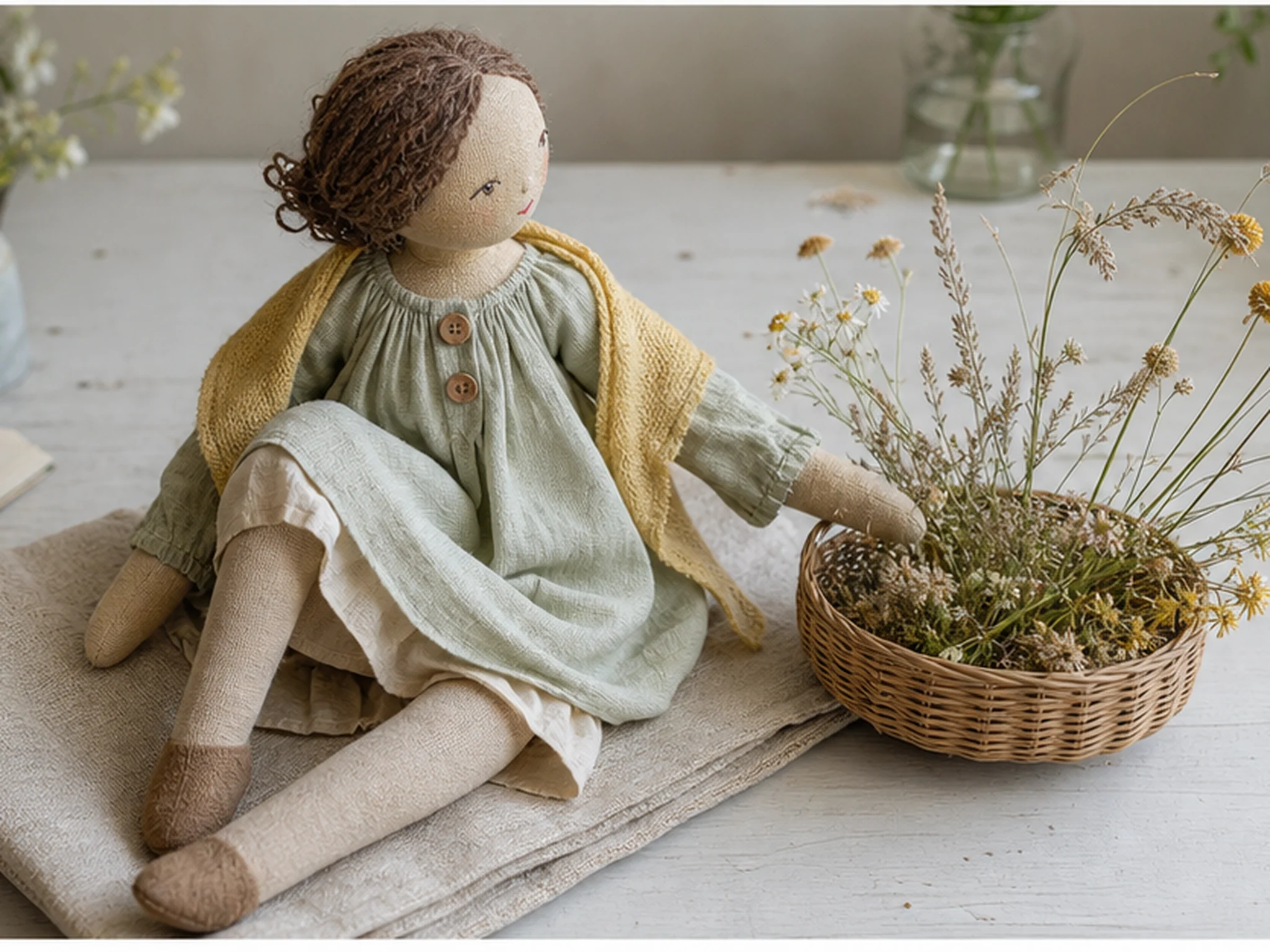
The strongest works are not necessarily the most elaborate. Sayer edits by removing. A scarf disappears because it competes with the face. An embroidered branch is unpicked because it makes the dress too illustrative. The final object needs enough detail to reward close looking but enough restraint to remain open to the collector’s interpretation.
What a collector should receive
A well-documented art doll should arrive with more than the object itself. The maker should identify the title, date, dimensions, materials, edition status, and basic care requirements. For one-of-a-kind work, a signed certificate or invoice establishes a clear record of authorship and ownership. Photographs of the work at the time of sale can help document its original condition.
Sayer’s packaging uses an acid-free tissue layer, a stable inner support, and a rigid box. Accessories are secured separately so they cannot rub against the face or clothing in transit. The goal is not theatrical unboxing. It is to reduce unnecessary movement and preserve the work’s material character.
The appeal of these figures is not perfection. It is the accumulation of decisions: where a seam turns, how a skirt falls, which button was kept, and which stitch was allowed to remain visible. In that sense, the doll is not simply an image of a character. It is a record of making.