Essay
Why Handmade Matters
A useful defense of handmade work should move beyond nostalgia and look closely at labor, knowledge, material limits, and responsibility.

By Rina Calder
· 5 min read

“Handmade” is one of the most overworked words in contemporary retail. It can describe a single object built over several weeks, a product assembled by hand from industrial parts, a small batch produced with jigs and machines, or a factory item given one final manual step.
The word alone does not guarantee quality, ethical labor, originality, durability, or cultural sensitivity. Handmade objects can be poorly constructed. Machine-made objects can be excellent. The useful question is not whether a hand touched the work, but what kinds of knowledge and decision remain visible in it.
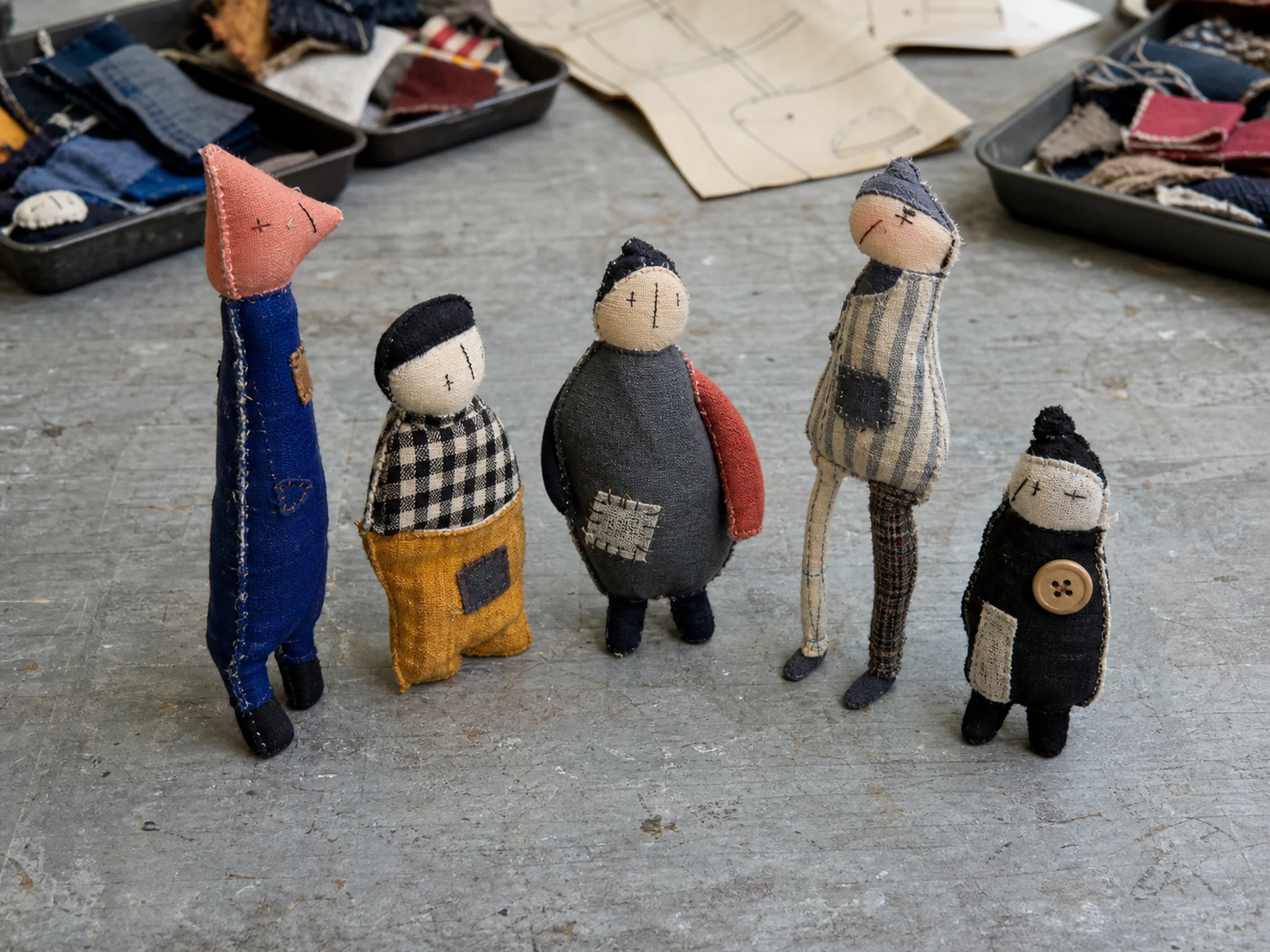
Art dolls make that question unusually clear. The figure has a body, clothing, surface, posture, and implied identity. Every construction choice affects how the object is read. A seam can be hidden or emphasized. A face can be modeled, painted, embroidered, carved, or omitted. A maker can reproduce a familiar type or invent a private visual language.
Handmade work carries process
In a mass-produced object, variation is usually treated as error. In handmade work, variation can be evidence: tension changing across embroidery, tool marks in wood, slight differences between two sculpted hands, or the way a fabric pattern lands differently on each body.
That does not mean every irregularity is valuable. Craft involves distinguishing expressive variation from structural failure. A loose joint is not made meaningful by calling it handmade. A cracking surface is not automatically patina. Standards still matter; they are simply applied through judgment rather than complete uniformity.
This is why process documentation is useful. When a maker explains materials, construction, and care, the collector can understand which traces are intentional and which changes need attention.
Objects preserve forms of knowledge
Handmade dolls have often carried knowledge that is larger than the individual object. Museum collections document sewing methods, regional dress, available materials, family economies, community enterprise, and cultural memory. A cloth doll may record how garments were cut. A beaded figure may preserve a specific decorative language. A homemade object from a period of economic hardship can show how skill and collaboration created value from limited resources.
The Smithsonian’s account of the Nancy Hanks rag doll, for example, connects one small cloth figure to a Depression-era community enterprise. Other museum collections preserve dolls whose clothing, materials, and construction reflect particular Native communities and artistic traditions. The Natural History Museum of Los Angeles describes a handmade fabric doll as an object carrying complex regional history and heritage.
These examples do not mean every contemporary art doll represents a collective tradition. They do show why a doll should not be dismissed as a lesser category of object. Scale and familiarity can make cultural information more intimate, not less significant.
Slowness is valuable only when it produces attention
Slow making is often romanticized. Time alone does not improve an object. Repetition can become careless, and an inefficient process can be physically harmful to the maker.
What matters is how time is used. Drying time allows a clay surface to stabilize. Resting allows the maker to see a face again with less attachment. Hand stitching makes it possible to adjust tension around a small curve. A prototype reveals where a joint needs reinforcement. Documentation records a decision for future work.
The value of slowness lies in feedback. The object can change in response to what happens during making.
The hand is also a labor question
A serious appreciation of handmade work must include price. If an object requires design, prototyping, material sourcing, construction, photography, listing, correspondence, packing, and aftercare, the final price cannot be compared directly with a superficially similar factory toy.
Collectors do not need to accept every price without question. They should expect clear materials, strong construction, accurate photographs, reliable communication, and transparent edition language. But they should also understand that “affordable handmade” often hides unpaid labor.
The healthiest craft economy is not one where the artist works indefinitely for symbolic appreciation. It is one where the maker can set boundaries, price coherently, and continue developing the work.
Repair can extend authorship
Handmade objects often invite repair because their construction can be understood. A seam can be restitched. A garment can be supported. A loose accessory can be reattached. But repair should not be improvised when the work is valuable or materially complex.
Contact the artist first when possible. Record what changed and what was done. Use reversible, conservation-informed methods. A repair becomes part of the object’s history, and future owners should be able to distinguish the original construction from later intervention.
Visible repair can be beautiful, but beauty is not permission to alter another person’s artwork casually.
Handmade should remain specific
The strongest language around craft is concrete. Instead of saying a doll is “lovingly handmade,” describe what happened: the body was cut from linen, filled with wool, joined with hand stitching, painted in thin layers, and dressed in a garment made from reclaimed cotton. Specificity respects both maker and collector.
Handmade matters when it keeps relationships visible: between material and form, labor and price, tradition and invention, use and care, artist and owner. Its value is not mystical. It is legible.